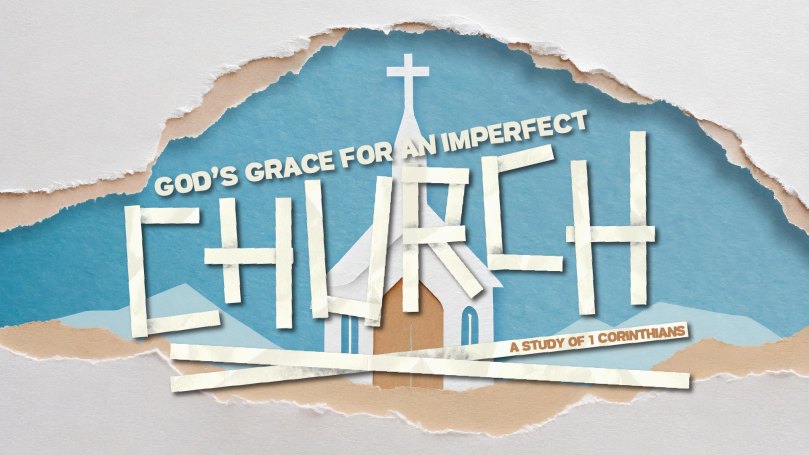
This past weekend at Eastbrook, we continued our preaching series entitled “God’s Grace for an Imperfect Church: 1 Corinthians.” In this message from 1 Corinthians 5 I took us through Paul’s strong words to the Corinthians Church around life and freedom in a message entitled “Living Alive and Free in Christ.”
You can find the message outline and video below. You can access the entire series here. Join us for weekend worship in-person or remotely via Eastbrook at Home.
“Therefore let us keep the Festival, not with the old bread leavened with malice and wickedness, but with the unleavened bread of sincerity and truth.” (1 Corinthians 5:8)
Living as a Community of Christ’s Life Amidst Confusion (1 Corinthians 5:1-5)
The situation in Corinth
The calling of the community
When we settle for less than life
Why calling the community to more is important
Living as a community of life means…
Living as a Community of Christ’s Freedom Instead of Enslavement (1 Corinthians 5:6-8)
Confusion over what freedom is all about
The freedom of the Exodus
The continuity of Jesus-followers in relation to freedom in Christ
Living as a community of freedom means…
Living as a Community of Christ in a World Needing Christ (1 Corinthians 5:9-13)
Living as a community of Christ
The upward calling in Christ
The world that needs Christ
Living as a community of Christ means…
Dig Deeper
This week dig deeper in one or more of the following ways:
Take some time to read through 1 Corinthians 5, noting what parts of the passage relate to individuals and what parts relate to the community in Corinth. Prayerfully reflect on the relationship between individual and community holiness. Talk with a friend about what you learn.
Join us for worship with Eastbrook Church through Eastbrook at Home at 8, 9:30, and 11 AM. This weekend we continue our celebration of Christ’s resurrection and also continue our preaching series entitled “God’s Grace for an Imperfect Church: 1 Corinthians.”
Here is a prayer for the Sunday after Ascension Day, the seventh Sunday of Easter, from The Book of Common Prayer:
O God, the King of glory, you have exalted your only Son Jesus Christ with great triumph to your kingdom in heaven: Do not leave us comfortless, but send us your Holy Spirit to strengthen us, and exalt us to that place where our Savior Christ has gone before; who lives and reigns with you and the Holy Spirit, one God, in glory everlasting. Amen.
If you are able to do so, let me encourage you to join us for in-person services at 8:00, 9:30, and 11:00 AM this weekend at the Eastbrook Campus.
If you are new to Eastbrook, we want to welcome you to worship and would ask you to text EBCnew to 94000 as a first step into community here at Eastbrook.
Each Sunday at 8, 9:30, and 11 AM, you can participate with our weekly worship service at home with your small group, family, or friends. This service will then be available during the week until the next Sunday’s service starts. You can also access the service directly via Vimeo, the Eastbrook app, or Facebook.
If you are not signed up for our church emailing list, please sign up here. Also, if you would like to support the ministry of Eastbrook Church financially, you may give online or send in your tithes and offerings directly to the church office.
“The Weekend Wanderer” is a weekly curated selection of news, stories, resources, and media on the intersection of faith and culture for you to explore through your weekend. Wander through these links however you like and in any order you like. Disclaimer: I do not necessarily agree with all the views expressed within these articles but have found them thought-provoking.
“Unique Byzantine Psalm inscription in New Testament Greek discovered in Judean Desert” – Gavriel Fiske in The Hebrew Times: “A rare inscription paraphrasing part of Psalm 86 in the Greek used in the New Testament has been unearthed by a team of Hebrew University archaeologists working at the Hyrcania Fortress, a Second Temple-era structure situated atop a forbidding hilltop in the Judean Desert, about 17 kilometers southeast of Jerusalem. Found painted in red, under a cross, on the side of a large building stone, the Koine Greek inscription reads: ‘Jesus Christ, guard me, for I am poor and needy. Guard my life, for I am faithful to you.’ In the original Hebrew psalm, known as ‘A Prayer of David,’ the first section reads, ‘Hear me, Lord, and answer me.’ A community of Byzantine Christian monks founded in the 5th century CE is likely responsible for the adapted Psalm 86 inscription. Dr. Avner Ecker of Bar-Ilan University, who helped decipher the inscription, noted that the writing contains small grammatical errors, indicating that ‘the priest was not a native Greek speaker, but likely someone from the region who was raised speaking a Semitic language.”
“The Healing Power of Church Architecture: Why we need holy spaces more than ever” – Jason Ferris in Comment: “As a young man living in New York, I often visited the city’s great churches and cathedrals. Most bear the name of a saint—St. Patrick, St. Thomas, St. John the Divine. I was not religious then, but I was drawn to these magical spaces and the peace I found inside them. It’s somewhat odd that these buildings still exist in the Manhattan landscape. The lots on which they sit are among the most valuable on earth, and New York has grown increasingly secular. When these churches were built, they were dramatic and imposing. Now they are dwarfed by modern high-rises that leave them in near-permanent shadow. Getting to these cathedrals can be stressful, because New York is stressful. You descend and ascend from crowded train stations. The noises of the street assault you. But upon entering a cathedral’s narthex, all of this slips away. The sounds of hydraulic brakes and car horns fade into silence as the massive doors close behind you. Your eyes adjust to the darkness, and shapes come into focus—statues in distant alcoves, lanterns hanging from the ceiling. Entering the nave, you hear your footsteps on the stone tiles below and a moment later hear them again as they echo against the vaulted ceilings high above you. There is a sensual feeling of spaciousness, quiet, and wonder.”
“A Levitating Jesus?: The Meaning of the Ascension” – Jason Micheli at Mockingbird: “Perhaps no other event on the liturgical calendar challenges what we know of the world more so than Ascension. How are we to speak intelligibly of such an event, knowing, as we do, that heaven is not ‘up there?’ I know not how Jesus departed, but I do know that he did not go up, up, up, and away. In some ways, Christ’s ascension is an item of dogma on the slimmest of basis. Only Luke mentions it and he does so twice. Read in isolation, Luke’s account of the ascension could create the impression that Jesus has spent the last forty days since his resurrection on terra firma but this is straightforwardly not the case. Luke tells us that on the third day after his crucifixion, the Risen Jesus encountered two disciples who were on their way home in Emmaus. Strangely, Cleopas and the other unnamed disciple do not recognize their traveling companion until ‘he took bread, blessed and broke it, and gave it to them. Then their eyes were opened, and they recognized him…’ Coincident with the instant of their recognition, Luke reports, the Risen Christ ‘vanished from their sight.'”
“Long-Term Influence in One Square Mile: A Redemptive Quest case study with Mike Bontrager” – In The Praxis Journal: “There’s a small town about an hour outside Philadelphia called Kennett Square. Tucked in Chester County, a rural area with equestrian heritage, this square mile is home to 7,000 residents, with tree-lined streets and brick architecture that make a picturesque backdrop for community life. Kennett Square is the unlikely setting for a redemptive quest that has spanned more than three decades, as Mike Bontrager has created lasting influence in business, community, and family. Through a series of moves that might have seemed foolish at worst and counterintuitive at best, he has activated teams toward an audacious vision that’s still in the making…..Mike came to learn that God’s unmerited love unlocks a transformation that goes beyond being a “good person” and opens the door to realize a vision of restoration that God has for the world. He began to ask what that meant for this young company he was growing. ‘I didn’t want us to be just a kinder, gentler version of Wall Street,’ he says. ‘I wanted us to think totally differently than Wall Street.'”
“Taylor Swift’s ‘TTPD’: Religious imagery for a spiritually syncretic era” – Kathryn Post and Madeline Macrae at Religion News Service: “When pop icon Taylor Swift disclosed her religion in the 2020 Netflix documentary ‘Miss Americana,’ she was unambiguous. ‘I live in Tennessee. I’m a Christian. That’s not what we stand for,’ she said in 2018 in response to Tennessee Republican Marsha Blackburn’s opposition to the Violence Against Women Act and LGBTQ rights. But these days, Swift’s faith appears more fluid. Her religious references are as eclectic as a Brooklyn thrift shop — well-worn Christian metaphors sit alongside a more bohemian mishmash of witchcraft, divination and paganism. Her newest release, ‘The Tortured Poets Department,’ is a patchwork of religious allusions, from good Samaritans and Jehovah’s Witnesses to altar sacrifices and prophecies. Whatever her personal beliefs, the syncretism displayed in the sprawling 31-song double album — which racked up 300 million listens in 24 hours, making it Spotify’s most streamed album in one day — is emblematic of the religious mishmash of millennial and Generation Z religion writ large.”
“Preserving the Wilderness Idea: What we talk about when we talk about wilderness” – Brian Treanor in The Hedgehog Review: “In 2018, Kristine McDivitt-Tompkins—an American expatriate living in Chile and the former CEO of high-end outdoor clothing retailer Patagonia—donated to the Chilean government one million acres of land held by Tompkins Conservation. Combined with nine million acres of existing federal land, the bequest led to the creation of five new national parks and the expansion of three others. Among the latter was the Pumalín Douglas Tompkins Park, named after McDivitt-Tompkins’s late husband. Doug Tompkins died in a 2015 kayaking accident after spending much of the previous two decades working to preserve wild Patagonian landscapes and ecosystems. The Tompkins Conservation bequest is the largest private offering of land ever made to a national government. Doug Tompkins had made his fortune as cofounder of both The North Face and the discount clothing brand Esprit before purchasing some forty thousand acres of land and embarking on semiretirement in Reñihué, Chile. This was not simply the story of another affluent American leveraging wealth to retire overseas. He had moved to Chile partly because of how decisively Patagonia had shaped him as a young man, when he and climbing gear entrepreneur Yvon Chouinard drove from California to southern Chile to make the third ascent of Fitz Roy, a 11,171-foot peak on the Chile-Argentina border. But Tompkins also returned because he had a vision: to protect and even add to the wildness of this pristine land.”
Almighty God and Father, thank You for Your everlasting love revealed in Jesus Christ, who did not consider equality with You something to be used to His own advantage, but emptied Himself and took on the nature of a servant and became human for us and for our salvation.
Thank You that in Your infinite wisdom this divine descent of the only begotten Son from eternity made the way of the Cross truly to become the pathway to abundant life.
Thank You that through His death and resurrection the gateway to eternal life not only brings us into Your household as children but also seats us in the heavenly places where He now lives and reigns with You eternally.
As we enter into true life through Him, and we enter into Your forever family through Him, so, too, do we find ourselves held in prayer through Him, as He eternally intercedes for us at Your right hand, Jesus the Messiah, ascended to glory, the Name above all names, and our High Priest forever.
For all these blessings beyond anything we could ask or imagine, we thank You.
May our lives – in thought, word, and deed – exist as living sacrifices of worship to You, who reign with Your only Son, Jesus Christ, and the Holy Spirit, One God, forevermore. Amen.
This past weekend in my message, “Fools for Christ,” I explored some aspects of finding identity with God through Christ. To help us grasp this, I’d like to explore a little more deeply than I could in a Sunday sermon what personal identity is and how it is formed. Why do we have a sense of who we are as unique individuals? What is it that helps us get a sense of who we are, and how has that changed over time in our world?
Outward – the porous self
The philosopher Charles Taylor explores this idea in various places in his writings.[1] In his study of the concept of the human self, Taylor proposes that in the past, the sense of our selfhood, or personal identity, came through human connections to family, community, society and other things around us. He calls this “the porous self” because what is outside us is shaped through our pores – our interactions – with what is outside of us. Thus, the self is shaped outwardly; through relationships with what is outside of the self. There are certain cultures around the world where this is still largely true, but on the whole this approach to personal identity is a thing of the past in the Western world.
Inward – the buffered self
In contrast, Taylor, says, the modern sense of self, or personal identity, in the West is disconnected from the world around. He calls the modern approach to personality “the buffered self” because it has buffer zones – great separations – between the self and the world around it. In modern attempts at grasping personal identity, we do not move outward into connections with the communities or world around us. Instead, we turn inward to find our deeper desires, dreams, and the like. These become the raw material from which we shape our sense of identity. The challenge is that we find so much inside of us that is in conflict that we have to make value judgments and decisions about what we pay attention to. And here is where the lie of the buffered self reveals itself: we do not make these value judgments or decisions in a vacuum but, instead, make them in relation to communities or authorities that we choose to listen to, whether they are peers, medical authorities, theological authorities, voices from social media, or any other thing we put into a position of authority for ourselves.
Upward – the God-ward self
Into this conflicted place, if we are honest, we must realize that we need an authority to listen to, to learn from and, ultimately, to submit to if we want to answer the question: “who am I?” St. Augustine of Hippo, the great 4th-5th century philosopher-theologian from North Africa, speaks to the reality that our journey outward and our journey inward must lead us into a deeper engagement with the God who has made everything “out there” and everything “in there.” He writes in his book Confessions, “Let me know you, for you are the God who knows me; let me recognize you as you have recognized me.”[2]
Pastor Tim Keller helpfully points out that this third way could be referred to as “upward” as opposed to the “outward” approach of the porous self and the “inward” approach of the buffered, modern self.[3] In order to find ourselves, we cannot merely look outward or look inward but upward to One who is greater. If we want to break through the endless voices outside of and the endless voices inside of us telling us who we should be, we need the right authority speaking into our lives. If we want to know who we are, we must look to God, who has made us.
[1] Charles Taylor, Sources of the Self: The Making of the Modern Identity (New York: Cambridge University Press, 1989).
[2] Quoted in Brian S. Rosner, Known by God: A Biblical Theology of Personal Identity, Biblical Theology for Life (Grand Rapids, MI: Zondervan, 2017), 115.
[3] Tim Keller, Making Sense of God (New York: Penguin Books, 2016), 133-134.


 Renovate